Japan launches its own private space company – Mitsubishi Heavy Industries

The space wars are heating up. As it stands right now, the Russians have the biggest for-hire space program, but their fleet is aging. The new players on the market, like Space X, are competing for the future of that market.

Which will look something like this. Every country rich enough to afford it, and big companies, will be sending probes, satellites, and people into space. They will pay a private company to do so and eventually the market will be the opposite of what it is now, where governments dominate and private industry supports.

Here is an example of that:

A Japanese rocket has lifted off with a South Korean satellite in Japan’s first commercial launch of a foreign probe into space.

The HII-A rocket lifted off from a remote southwestern Japan island carrying the South Korean probe and three Japanese satellites.

Mitsubishi Heavy Industries, a private company in charge of HII-A rocket production since 2007, is hoping to compete with the U.S., Russia and Europe as a launch-vehicle provider. This was its first contract to launch a foreign probe.

The Korean satellite, KOMPSAT-3, was developed by the Korea Aerospace Research Institute to monitor the environment. The rocket also carried Japan’s Shizuku satellite to monitor climate change and two smaller Japanese probes.

via UT San Diego

HII-A Launch Vehicle

Hoots and Shakas – trailer for the San Diego Surf Film Festival

Don’t get scared – the shouting is called a “hoot” and the thumb/pinky salute is called a “shaka” – and that was the theme for the 2012 San Diego Surf Film Festival, Hoots and Shakas.

Amy and I attended the festival and had a blast (you can see us at 0:37 in the video). We met all sorts of people, including the maker of this video Michael Emery (his company).

It was multiple days of stoke in the water (check out the seal waving to Michael) and in Bird’s Surf Shed watching surf films.

Enjoy the video – Steve

w/

Africa is experiencing the biggest falls in child mortality ever seen

Child mortality in Africa has plummeted, belying the continent’s “hopeless” reputation.

The chart below shows the change over the most recent five years in the number of deaths of children under five per 1,000 live births.

Sixteen of the 20 have seen falls, but the more impressive finding is the size of the decline in 12: more than the 4.4% annual fall needed for the world to achieve its millennium development goal of cutting by two-thirds the child-mortality rate between 1990 and 2015.

The top performers, Senegal and Rwanda, now have rates the same as India. It took India 25 years to reduce its rate from around 120 child deaths per 1,000 births to 72 now. It took Rwanda and Senegal only about five years.

Michael Clemens of the Centre for Global Development, a think-tank in Washington, DC, calls this “the biggest, best story in development”.


via Economist Daily Chart

Netflix updates web player – slick controls and extra features

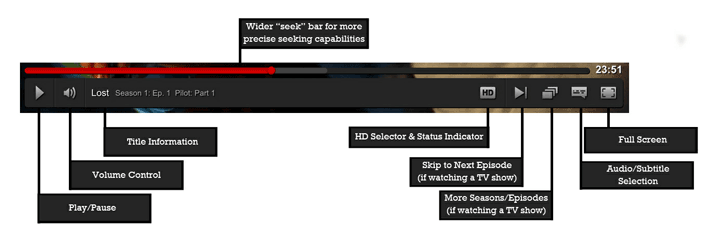
If you watch movies and TV shows streaming from Netflix on your PC or Mac you may have noticed that we have updated our Web video player. We’ve refreshed the look of the existing features and added some new functionality.

Some of the new features include:

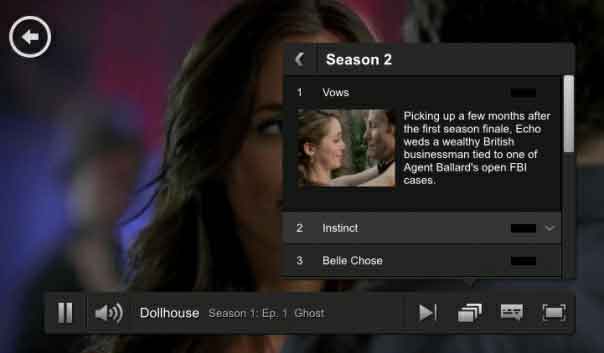
  • You can view season/episode information and change to the next episode when watching a TV show
  • The size of the controls now scales, making it easier to use the player on large screens, for example if you connect your computer to your TV
  • Similarly, the player will scale down to smaller windows, which is useful if you want to watch something while working in another window.
  • Pausing the video now shows more information about the title

In our new player, we’ve consolidated controls into one line. We’re also using icons instead of words (see image below).

Perhaps the biggest change is to the ‘Back to Browse’ option, which used to sit at the bottom right of the old control bar. We’ve moved this up to the top of the screen and to the left. It’s now an arrow icon and text will explain its functionality when you hover over the arrow with your mouse.

via Netflix Blog


And, more detail from Janko Roettgers:

Additional episodes of a TV show can be previewed right from within the player, even in full-screen mode.

The player makes way for additional information, lightbox-style, when paused for a few seconds.

‘Ring of Fire’ – solar eclipse coming this Sunday

There will be a stunning partial solar eclipse on Sunday, May 20th. The moon will begin shrouding the sun at 5:27 p.m. (PST) and will cover 83 percent of the sun’s surface at 6:40 p.m. The eclipse will take place while the sun is sinking toward the horizon, out over the ocean. It’ll be easy to see, if skies are clear.

Do not — repeat, do not — look at the eclipse with your naked eye or with materials that don’t protect your vision from UV and infrared radiation. You risk permanent and serious damage to your vision if you don’t use the proper safety equipment to view a solar eclipse, and the damage can occur within seconds.

via Gary Robbins


Continue reading “‘Ring of Fire’ – solar eclipse coming this Sunday”

Siberian Free Soloing – crazy story of locals climbing en masse

Climbers Jonathan Thesenga and Brittany Griffith are the first Americans to climb at Stolby, a central Siberian nature reserve, where the locals free solo en masse.

Comment:

Good afternoon! I live in Krasnoyarsk and itself each days off I go there. I confirm, many (a lot of, much) person there goes, but is far from being all climbing. Basically people rise on the simple courses, not representing to serious danger. They do not demand rocky footwear and cords. Complex (difficult) courses many go with equipment – cords, обвязки, delays, carbines. The basic danger on Columns not absence of a cord, but insects, the spiders called “клещами”, carrying fatal chronic diseases.

Google takes a big step towards becoming a (smart) encyclopedia – look out Wikipedia!

“We’re in the early phases of moving from being an information engine to a knowledge engine” – Google

That’s a quote from the video below where Google explains a new panel they are adding to search. Called the ‘knowledge graph’ it is basically a mini-encyclopedia. See the panels in the images below.


This is a big competitive move for Google. Not only are they taking on Facebook with Google+, Microsoft with Google Docs, and Apple with Android, now they have Wikipedia in their sights.

Of course, Wikipedia will still serve a huge purpose for in-depth information, but you can expect Wikipedia to experience a precipitous drop in page views once people are getting their basic information from these panels.

It also puts Google in an interesting position. While this is a natural improvement in search it also creates a conflict of interest for them. One of the many they are currently facing, some of which are in the courts facing anti-trust issues.

Will Google devalue Wikipedia in favor of their ‘knowledge graph’?

Or, lower its ranking if people begin using it less?

Hard to predict, but notice that in the images above Google clearly (intentionally?) shows Wikipedia as the top result. That may not keep.


Learn more: