Do you use Apple gestures, have you even heard of them?
I was first introduced to them in January of 2008, when I became hipster #1 and bought the first MacBook Air. Now, three years and eight months later I am still barely using them.
Of the available fourteen there are only three I regularly use but those three are absolutely time-saving-revolutionary.
Scroll with two fingers – just move two fingers up/down, instead of turning a mouse wheel or dragging the sidebar.
Forward/Backwith two fingers – browse the web by “swiping” left or right with two fingers, no more back button.
Double-tap with two fingers – instead of the right mouse click (called a “secondary click”), tap two fingers to engage a secondary click.
When Apple says they are “fluid, natural, and intuitive,” I wholeheartedly agree. I don’t think about using them anymore and it hurts to use a computer without them. Which is when you know it’s a true innovation, “when you can’t live without it.”
Of the other fourteen, I have three more just barely in my memory. Six out of fourteen?
It does take a while to break the old habits, especially for former Windows users. No more mouse and an almost entirely new language with my fingers. Yeah, it’s tough but I can’t complain about clicking less buttons and gaining agility.
It’s part of the reason why I like Apple products. Their agressive forward pace, while offensive to some, keeps me on my toes and ever-improving. I can only imagine the day when I am able to handle all fourteen:
[one_half]
Single click
Dictionary look-up
Directional scroll
Smart zoom
Rotate
Scroll between screens
Open Expose
[/one_half]
[one_half]
Secondary click
Window drag
Zoom in/out
Scroll forward/back
Open Mission Control
Open Launchpad
Show desktop
[/one_half]
Watch out too because these gestures are growing exponentially. On my last computer there were only 6-7 and now fourteen. It won’t be long before there are 72 gestures encompassing every feature on a computer.
We may even begin to skip the keyboard…have you seen the Swype text-input on Android?
This morning I created 150,000 jobs. I put into motion a plan to support small business and fix healthcare.
Don’t believe me?
It turns out you shouldn’t believe the politicians either.
It’s obvious that Obama is struggling with job creation. His main Republican opponents, Rick Perry and Mitt Romney, are playing that against him.
Both claim they created 1,000s of jobs while in office and are even pinning their campaign on it. They directly state that they are responsible for job creation:
They are not alone. All politicians make this claim as if fixing potholes and firing teachers creates jobs. Of course, some of the best will try to convince you that cutting business taxes or creating a “friendly climate” is what it takes.
Talk about timelessness of good writing. Somehow, with pitch-perfect lucidity, Charles Dickens over a century ago eloquently described my summer.
Starting with leaving DC. In the weeks leading up to our departure, Steve and I had some of the most tempestuous showdowns I’ve ever endured, including a 5-hour fight (five f***ing hours) that ended with me trying to hit him with a tin bucket of dirt and him catching it and dumping it on my head. I can’t even write those lines without laughing, but at the time, it was intense and devoid of any humor whatsoever.
I wanted to leave and I didn’t. DC was home for me. But if you’ve ever tried to fill up on tofu or non-meat substitute when all you’re craving is a hamburger, no matter how much “toburger” you consume, it just doesn’t cut it.
I needed a solid break from everything I was trying to fill up on that wasn’t fulfilling me. So I moved 3,000 miles across the country to Southern California to pursue screenwriting and a different way of life. And I found a happiness that I haven’t felt in a long time.
I took up surfing and after at least 50 (maybe it was 100 times) falling down, I finally rode a wave. Anyone who has ever surfed knows that first wave you ride makes all the times falling down worth it.
I needed surfing. It’s been my salvation. After struggling to get off Adderall for the past two years I finally cut the cord. I needed something to replace the mental and physical “stamina” and “focus” Adderall gave me and I found that in surfing. When I’m in the water, I find that edge I’m looking for, and afterwards, I have a sense of peace and clarity of mind Adderall never gave me.
And I’ve been writing, a lot. I completed the first draft of a second screenplay and finished a 10-week Advanced Screenwriting class at UCLA, rewriting my first screenplay and learning the things you won’t find in any screenwriting book. Which has been the best part of my summer and the worst.
No matter how much I love writing, no matter how much I write, no matter how many people read what I’ve written and say they love it, I still have my moments of doubt when I ask myself, What the hell are you doing? Which is really code for, How far are you willing to go to make this happen, to make this a career and not just an interest and indulgence?
The answer is always the same. Pretty far. This summer I came to the conclusion that this is what I want to do, this is the life I want, which is a pretty big pivot.
So if you ask me to describe my summer, instead of quoting Dickens, I’ll sum it up with one word: gnarly.
In the fast food industry, a recent report states that Subway is now the worlds largest fast food chain, displacing McDonalds. There is also a booming salad industry with an explosion of salad fast food chains.
Perhaps the fast food industry will save us?
Well, remember the cliche: “I’m on a diet so please give me a Diet Coke instead of a Coke.”
I think that fits as an analogy here.
Just saying you’re eating a salad doesn’t mean you are eating well. One could skip the hamburger for the salad then load it up with dressing and fried chicken. A report from ABC’s Good Morning America, points out that in many cases the salad is equally fatty or worse.
They point out that iceberg lettuce, which accounts for much of the salad, has “zero nutrients and zero fiber.”
Which is where I draw the line.
—
The story is all wrong. Yes, iceberg lettuce can be at zero, but so can everything else we eat. Let’s not take an entire crop and label it as useless.
Instead we should understand the nature of food. First and foremost, quality is the most important aspect of food and not all are created equal. Or, put another way, vegetables that are grown from quality seeds and harvested when ripe are densely filled with nutrients.
But, if you buy vegetables from a supermarket or fast food chain, you are not getting this. Instead, you are purchasing the cheapest food money can buy. Which means they are harvested before they are ripe and grown from the cheapest seeds.
There’s more. A growing number of items, like tomatoes and strawberries, have been modified to produce extra sugars. Added together you have produce practically empty of nutrients but with extra sugar.
Fantastic.
Even if you choose the best supermarkets have to offer, you skip the dressing, choose a lean meat, and all that…then the best you can do is “the cheapest food money can buy.”
A lot like choosing the Diet Coke.
—
If you’re new to this, here a good way to think about it.
Take the typical supermarket salad and cut it in half. That should be your portion size when eating high quality food. It should make you feel full and it should be delicious.
The reason for this is the dense amount of nutrients in the food which also makes it taste much better. Decrease the amount of nutrients and you will increase the amount you eat. It’s as simple as that.
Now, how long do you think it will take for 2/3 of America to understand this?
Sometimes you can spot the tomatoes that are "densely packed with nutrients"
A quick recap is that by eating at farmers markets you gain superior health and weight loss, prevent global warming, and save money.
For the longest time, I wondered why nobody else understood this. It turns out that since 2000, many, many more people are starting to agree with me.
Check out the graph provided by the USDA in their annual farmers market audit:
Notice that since the recession, the so-called “expensive” markets are surging with 164% growth since 2006. If this trend continues we may finally be able to impact our food system.
I can already see it happening in the supermarkets where the words “farmer”, “market”, and “local” are everywhere. Too bad they are only marketing terms.
So next chance you have, stop by a farmers market for the real thing. Pick out some fruits and vegetables. Come back the same time next week and keep the farmers market revolution going!
Despite all the haranguing on our economy and jobs market, why aren’t we talking more about the massive labor imbalance in our country?
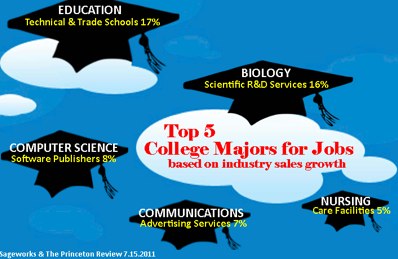
A recent Rutgers University survey of 571 Americans who graduated from college between 2006 and 2010 found that only 53% held full-time jobs. And yet, it’s not hard to understand why. In 2009, of the 1,601,000 bachelor’s degrees conferred, the greatest numbers fell into the fields of business (348,000); social sciences and history (169,000) and health sciences (120,000).
I had to look up health science and found this description:
The health sciences are concerned with the development of knowledge and programs related to health and well being. Health science is also concerned with the study of leisure and cultural phenomena.
And just so we’re all on the same page, social sciences include: anthropology, archaeology, communication, criminology, political science, sociology and psychology.
I’m going to refrain from commenting on the social and health science and history majors and instead take a moment to focus on business majors. You would think having a prevalence of business majors would be a positive for our economy, but we first need people who can actually make something before we need the people to market, sell and manage it.
We are missing the makers (engineers and scientists), the people who have the skills and knowledge to create something.
The fact is, there are jobs in this country. According to the most recent report from the Bureau of Labor Statistics, over three million job opportunities are unfilled in the United States right now, the highest level in three years. And yet, in that same period we have produced the highest unemployment rate we’ve seen in over two decades.
I was at my alma mater (James Madison University) a few months ago and caught up with a former professor in the college of Integrated Science and Technology (ISAT) ; she told me that enrollment numbers in ISAT were the lowest they’ve ever been, even though these students are the most desirable and in demand by employers. Given the current economy and jobs market, I was a little shocked.
I’ll be honest here and say that when I was 17, college and majors didn’t consume my thoughts nearly as much as boys and field hockey. I went to JMU because it had the best field hockey program in the country. And my parents essentially chose my major for me. I was pretty ambivalent about what I wanted to do. There was lots that interested me (minus Accounting). At one point it was Law, another time English, I even considered Business. But my parents reasoned that I was good at math and science and the world needed more women in STEM, so I said sure, why not.
When I graduated, I had 15 job offers. Looking back, I’m certain my collegiate experience would have been a lot easier if I majored in something that didn’t require me to spend so much time in computer and science labs, but in this tech-centric day and age, I’m glad I left knowing how to program and build a website, amongst other things.
How many young Americans today think about employability? If you look at the degrees that are most likely to land a person a job, there seems to be a disconnect with the majors students are pursuing the most. Case in point, in 2009, degrees in “parks, recreation, and leisure studies” saw a 43 percent increase. Yep, the things with budgets first to get cut in a recession are what students are flocking to.
I’m not saying people should neglect their true callings in life. In fact, I think the world benefits the most from the people who vigorously pursue their passions, including social psychology majors (who have the highest unemployability rate). But for those who aren’t so sure what path to pursue, wouldn’t it make sense to take a look around, at the state of the country, and consider majoring in something employable?
Incidentally, it seems the United States isn’t alone in its labor gap. A recent report from the British Chambers of Commerce reveals small businesses are frustrated at the quality of applicants, who they say can barely concentrate or add up. The report warns: ‘Too many people [are] coming out with fairly useless degrees in non-serious subjects.’
Amid the celebrations and acts of unity, I want to reflect on how the world has changed. More specifically how we have changed, and will that prevent another attack from happening.
What really caused 9/11?
There are so many explanations, if I miss one please tell me, but here are the ones I look to: oil, the Middle East, our military but more specifically our geo-political strategy, and our security around the world.
Oil
U.S. oil consumption has remained steady since 2000 when it was 19.7 million barrels of oil/day. In recent years a slight dip has occurred maybe due to the recession or due to structural changes (improved car MPG), and is now at 19.2.
Which is very good news. Not only have we handled our economic and population growth without increasing our demand, we have even reduced it. Economist call this “demand destruction”, one of my favorite terms.
It is quite possible that we have turned the corner on fossil fuels (or reached “peak oil”). If so, one of the main sources of terrorist funding, recruiting, and anger may be fading away.
The Middle East
Then we can look to the Middle East, where all 19 hijackers were from. The vast majority of them (15) were from Saudi Arabia, which backs up the oil topic. The remaining ones were from Lebanon, Egypt, and two from the UAE.
It’s great that we took down the Taliban in Afghanistan, even though it is not in the Middle East (South-Central Asia). They were bad and needed to go. Their replacement is not perfect but a whole lot better, with room to grow, unlike the Taliban.
The Arab Spring changes everything, though.
Before the uprisings, there were no democracies in the Middle East (only 26 in the rest of the world). Many of the new governments are on track to change that, but remember that even in our own past, the road is rocky and violent.
The good news is that three evil, violent, and obnoxious dictators are out of Egypt, Libya, and Tunisia. Eight other countries had major uprisings and six more had minor ones, with multiple reforms across the board.
All in all, it looks to be a general improvement.
Military Presence
The cult of Al-Qaeda was formed due to one very important factor, one that Osama exploited to no end. We have our military in several countries.
From our point-of-view this is a rational geo-political strategy to protect our interests. In the early days, we also protected the people from dictators and warlords.
Then at some point we started supporting more corrupted leaders than reformers. When one is bad, several is more than enough to cause hatred.
Which explains the opposing point-of-view. We often crossed that fine line between bully and protector, and usually for our own oil interests.
Yet, the situation hasn’t changed, in fact, it’s gotten worse. We now have our military in more places than ever, with many long term contracts in place to keep it there.
This is a problem and will not go away and was recently highlighted by crazy guy #1 in Iraq, Moqtada Al-Sadr’s statement, (paraphrasing): “don’t kill the Americans, they are leaving.”
Security
It’s hard to travel when everyone hates you. I went to Europe in 2004 and so many of those wealthy, pacificist, socialists hated us. They had signs up about our “invasion” of Iraq.
Now imagine how people in Muslim countries feel. It’s gotten to the point that if we are not giving money to a country, they hate us (and some still hate us when we do). We have to build monumental fortresses just to have embassies. Our checkpoints are becoming comedy acts of creative bomb making.
US Embassy, El Salvador
Where else can we possibly stick a bomb when traveling?
The only good news is that, for some reason, foreigners like Obama.
I don’t really get it. Maybe it’s that he’s not white. Maybe it’s because he was against the Iraq war and talks about removing troops. Or, maybe it’s just because Bush labelled so many as enemies that it became us-or-them.
Who knows.
The good news is that foreigners still like him after he announced the troop increase in Afghanistan. If he gets re-elected then he can do more international rock-star tours and keep building up that goodwill.
Then maybe I can travel abroad and not get the evil eye from everyone.
But then again, if a Tea Party-er gets elected we might start calling everyone extremists and enemies. It would be great if they added ‘isolationism’ to their pseudo-retro movement.
Conclusion
I think everything begins and ends with oil. If we are truly past peak oil then things are getting better. We can stop (or decrease) the use of our heavy hand in the Middle East to maintain our oil supply.
Our military can draw down and our goodwill will go up. Which will take years of course, but it will mean our state of affairs is getting better.
We just have to keep making those hard decisions to get us off oil, though, with shaded solar parking lots, maybe it’s not so hard after all.
I’ve never done a recipe post before, but I have to talk about my breakfast burritos and fish tacos. In the small world of “me” they are legendary.
I’ve started surfing and my apetite is ravenous. Being from Southern California I have to – absolutely required to eat fish tacos.
Fish Tacos
The best place to enjoy a fish taco in Orange County is the secret spot, Bear Flag Fish Company. The place is always packed with surfing families, potheads, and high school dates. No need to recommend anything because you should try them all.
They also sell fish by the pound (sometimes local fish too). This is where I start my fish tacos by ordering up a pound and grill it at home.
Fish is the easiest thing in the world to BBQ. Just throw it on the grill, cut down the middle to check it out, and when dry but oily take it off.
Next comes cabbage, the secret fish taco ingredient. Not much taste to cabbage (red or green) but it is a crunchy-wet-filler for the fish.
Tortillas, say it like this: torrrr-tiya with as slick an accent as you can produce.
I use small corn tortillas that smell delicious, which as far as I can tell is the only way to determine quality. Heat them up a little first (10 seconds in microwave).
Lay the fish down first and the cabbage on top of it.
If you prefer the creamy route then lay down some sour cream with hot sauce on top. This is key, you must lay the hot sauce on the cream, it’s magical that way.
Vegetables, like pico-de-gallo (diced tomatoes, peppers, onions) or avocado round out the fillings.
Just remember that less is best, don’t make a potpourri.
Breakfast Burrito
The tacos are for dinner but in the morning it’s all about the breakfast burrito.
The challenge to making a good breakfast burrito are the potatoes. These crunchy delights serve up the best burritos but take forever to prepare. Your best bet is to pre-cook them on a weekend or something and make a huge batch.
Boil them, then pan-sear ’em (turn pan on high, burn/crisp as much as possible, maybe use oil).
With taters in hand move on to the typical ingredients: large flour tortillas (heated in microwave, 10 seconds), eggs, sour cream, pico, avocado, sausage, etc.
The key is to combine the taters and warm tortillas with the best ingredients on hand. If needing protein go for a meat (sausage or soy-rizo, which is spicy tofu) or eggs (scrambled vs easy). If not, go the vegetarian route.
I only buy food at the farmers market so the ingredients always change. Right now the best item I’ve found are bean sprouts, I don’t know what kind but they are tasty and healthy.
Enjoy making your Mexican-American feast and share any tips you have!
The company uses 260 million watts which is the output of 1/4 of a nuclear power plant.
For each google search we use 0.3 watt-hours of electricity. I’m not sure how much that is but I do like the idea of server firing up when I type in “chad ocho cinco”.
Electricity is the problem of the decade and any bit of savings we can get are huge. A little research shows that retail prices are shooting up, over 41% since 2000 (3.5%/year), and expected to go even higher.
Without further ado, here are my 5 favorite energy saving tips.
1. Hang-dry clothes like it’s Little House on the Prairie. There ain’t no shame in letting your undies fly in the wind.
2. Shower quicker or turn off the water during the lather phase. It feels weird at first but you get used to it. Remember, every time you touch warm water you are paying to heat it up. Do you use warm water in the hot summer to wash dishes or your hands?
3. LED bulbs require some new knowledge. If you shop for one here is what the package will say, “6 Watt LED Replacement for a 50 Watt Incandescent.” That’s a near 90% reduction in lighting costs if you switch to LED but it’s not yet cheap with bulbs going from $12-30.
4. Fresh Air…my mom raised me on the stuff. Always opening the windows for me to make sure I didn’t get stuffy. Now I need it all the time and that means no A/C for me. I would rather sweat than breath recycled air. Huge energy saver for me.
5. Solar charger for phone. Life is better off the grid and to get started I purchased a solar doohickey. I haven’t plugged in my phone or iPad since. Tip: When buying solar, know that solar panels only produce energy, which means you need a battery pack to store the energy, otherwise you have to plug your phone in when the sun is shining.
Above all remember that even the worst depression is curable, even if you alone can’t cure it. The turning point can come at any time, maybe without your even realizing it.