Beautiful photos from National Geographic’s Best Environmental Photos 2011. Here are my two favorites:
Fish flee the gaping maw of a Bryde’s whale, which surprised…(the photographer, who said) he snapped the picture while also fleeing the whale.
A pack of African wild dogs attacks a warthog in northern Botswana.
They live in packs that are usually dominated by a monogamous breeding pair. The female has a litter of 2 to 20 pups, which are cared for by the entire pack. These dogs are very social, and packs have been known to share food and to assist weak or ill members. Social interactions are common, and the dogs communicate by touch, actions, and vocalizations.
African wild dogs hunt in formidable, cooperative packs of 6 to 20 (or more) animals. Larger packs were more common before the dogs became endangered. Packs hunt antelopes and will also tackle much larger prey, such as wildebeests, particularly if their quarry is ill or injured. The dogs supplement their diet with rodents and birds.
Slate recently did a piece on why Second Life, the virtual reality world, failed. It concludes, rightfully so, that the Linden Labs creation world lacks a clear purpose. Given how significant this factor is in the “real world” — people with a strong purpose and vision in life thrive, while those who lack direction, don’t — the rationale makes sense. In the words of Kit DeLuca (Pretty Woman): “You gotta have a goal. Do you have a goal?”
But there’s something missing, and I believe it’s an even bigger part of the equation: social, more specifically, Facebook. Second Life launched in 2003. Facebook came out in 2004 and with it came the rise and explosion of Zynga games, FarmVille and CityVille.
If purpose is the defining factor for success, then why is one of the most purpose-driven games in the world, World of Warcraft, losing players? My answer: Facebook. Blizzard Entertainment’s now seven year-old brainchild has been losing players since last October and has lost ~two million subscribers during the last 12 months.
Let’s compare this to The Sims Social, the Facebook addition to the Sims series. By augmenting the videogame with a Facebook edition, it expanded its user base and is second only to CityVille, Facebook’s most popular leisure activity.
Second Life failed because Facebook became our new virtual world, our “second life.” The alternate world is simply too disconnected from where people spend the majority of their time online.
Just to preface this video for anyone who has never surfed: the ocean, and specifically surfing, has a way of teaching humility and respect for Mother Nature in a way few things can. It’s tough to comprehend the true size and power of a wave is until you’re staring it down, in the water, just you and your board. You realize this incredible act of energy and inertia can swallow you whole, like some Melvillian Moby Dick scene.
In the case of surfing, if you’re not actually in the water, objects are always way f’ing bigger than they appear. You are the bomb, Garrett McNamara.
Sometime on Monday, October 31, 2011, a Halloween baby was born. This special tyke is the 7 billionth human being living on our planet. An incredible number that shocks, interests, awes, and scares all of us.
Here are some interesting facts about this major milestone.
Standing shoulder-to-shoulder all 7 billion of us would fill Los Angeles (so space is not the problem).
Today there are 5 births for every 2 deaths.
We speak 7,000 languages.
And, we live in 194 countries.
Now, get ready for this. We are not going to stop at 7 billion, with many expertspredicting that we will peak at around 9.5 billion sometime in the middle of this century (~2050).
Which brings up a whole slew of questions. First, food, where agriculturists expect “supplying food for nine to ten billion people will not be an issue.” Though, distribution will undoubtedly continue to be a problem.
Second, how are all of these people going to live. The trend is a massive urbanization of the world’s population. Our cities have grown to titanic sizes with the current unit of measurement being 10 million or more residents, called a megacity.
Keep in mind that up until the industrial revolution in the early 1800s, no city in the world ever had more than a million and change. As the revolution took hold, cities like London and New York quickly sprouted up to 10 million and beyond.
Today, there are 26 megacities with the 10 largest having populations beyond 20 million. Before this growth is complete another 25 will join the ranks.
Imagine that, a world with 50 megacities. Should make for some exciting travel opportunities. Here is how they will likely be spread out:
8 in China
6 in the US
6 in India
6 in Latin America
4 in Africa
3 in Japan
3 in Europe
Though, as the world matures we might see some drastic changes. For example, if Africa gets on the right track it could quickly become the new growth zone.
Which brings up the third topic: growth areas. It shouldn’t surprise anyone that most of Europe isn’t growing. The majority of its country’s have reached their ideal population size, with growth rates steady or even slightly shrinking.
Now compare that to the fastest growing countries who will be doubling their population in the next 15-20 years: Liberia, Burundi, Afghanistan, Western Sahara, and East Timor.
The demographers have noticed this too and concluded the following. First world economies have already reached their peak population, the fast-risers like India and Brazil are booming, and the third-world countries have yet to experience their growth.
Modern medicine, sanitation, and capitalism have yet to reach certain areas of the world.
The United States is still booming (0.97%) despite being a first-world economy, and China is not with a growth rate (0.48%) half that of the United States and very close to the European rates.
Fourth, and final point involves the sustainability of all these people. We can barely keep this planet functional with 7 billion people, so imagine how much worse everything will get with 2.5 billion more people.
The good news is that many places in the world are working hard to create sustainable cities in tune with nature and civilization. The place where I live, Huntington Beach, is one such example.
They have created a space for endangered birds and marine life which also serves as a stormwater run-off cleanser. The result is a booming wildlife population alongside a burgeoning surburban population, both living sustainably together.
Even more these moves are saving the city money and reducing the taxpayer burden, through a combination of community involvement and non-profit management.
As we move forward and another billion children are born, there will be a growing need for more of these win-win sustainable solutions.
Sometime on Monday, October 31, 2011, a Halloween baby was born. This special tyke is the 7 billionth human being living on our planet. An incredible number that shocks, interests, awes, and scares all of us.
Here are some interesting facts about this major milestone.
Standing shoulder-to-shoulder all 7 billion of us would fill Los Angeles (so space is not the problem).
Today there are 5 births for every 2 deaths.
We speak 7,000 languages.
And, we live in 194 countries.
Now, get ready for this. We are not going to stop at 7 billion, with many expertspredicting that we will peak at around 9.5 billion sometime in the middle of this century (~2050).
Which brings up a whole slew of questions. First, food, where agriculturists expect “supplying food for nine to ten billion people will not be an issue.” Though, distribution will undoubtedly continue to be a problem.
Second, how are all of these people going to live. The trend is a massive urbanization of the world’s population. Our cities have grown to titanic sizes with the current unit of measurement being 10 million or more residents, called a megacity.
Keep in mind that up until the industrial revolution in the early 1800s, no city in the world ever had more than a million and change. As the revolution took hold, cities like London and New York quickly sprouted up to 10 million and beyond.
Today, there are 26 megacities with the 10 largest having populations beyond 20 million. Before this growth is complete another 25 will join the ranks.
Imagine that, a world with 50 megacities. Should make for some exciting travel opportunities. Here is how they will likely be spread out:
8 in China
6 in the US
6 in India
6 in Latin America
4 in Africa
3 in Japan
3 in Europe
Though, as the world matures we might see some drastic changes. For example, if Africa gets on the right track it could quickly become the new growth zone.
Which brings up the third topic: growth areas. It shouldn’t surprise anyone that most of Europe isn’t growing. The majority of its country’s have reached their ideal population size, with growth rates steady or even slightly shrinking.
Now compare that to the fastest growing countries who will be doubling their population in the next 15-20 years: Liberia, Burundi, Afghanistan, Western Sahara, and East Timor.
The demographers have noticed this too and concluded the following. First world economies have already reached their peak population, the fast-risers like India and Brazil are booming, and the third-world countries have yet to experience their growth.
Modern medicine, sanitation, and capitalism have yet to reach certain areas of the world.
"Oranges and Oil - a Combination That is Hard to Beat," Circa 1921
“March 11, 1919 put Orange County in the black in more ways than one. On that day Fullerton area citrus grower Charles C. Chapman watched as his gusher came in. Thousands of gallons of crude oil flew into the sky at Chapman No. 1, his Placentia-Ritchfield District well leased to the Union Oil Co. This well began producing 8,000 barrels of oil a day and quickly became the most productive single well in California.
Representatives of Rockefeller family-controlled Standard Oil were impressed, too, and scouted the surrounding countryside. Standard quickly leased the Samuel Kraemer property across the street and drilled six wells including the deepest “Kraemer Zone” well. All were productive in 1919.
The county’s single most productive “soil product,” crude oil, accounted for nearly on fourth of 1912’s $26 million countywide take. After Chapman No. 1 came in in 1919, estimates put the county’s production at 1,475,000 barrels a month, which equated to $22.15 million a year.
Standard Oil was quick to exploit the newfound oil potential of Orange County and quickly leased 500 acres in the northwestern of Huntington Beach. By 1920, the first well, A-1, was bringing in 91 barrels a day. The town’s sleepy population of about 2,400 in the late teens nearly quadrupled by 1922, changing forever the face of the coast as derrick forests spread to the beach.”
– From Orange County 2000, The Millenium Book, pg 54, Chapmans Gusher
Huntington Beach Pier, circa 1930s
“A third strike in 1933 had world wide impact because of the new techniques it demonstrated. Up until that time, drilling had been on he near-vertical, directly over an oil pool, With the invention of controlled directional drilling, first used successfully here to tap the tide land pools, a well could be drilled on a slant, in any desired direction. Within a year, 90 wells were producing from tall rigs along the coastline.
These bobbing pumps remained the symbol of coastal Huntington Beach for many years and were frequently used as background for movies, including “Giant.” Now, most are gone or masked by plantings.
“Cal Nagel says, “It may have been ‘a stinkin oil town’ to the outsiders, but for the natives it was a comfortable small town of about 5,000 people. Before, we knew each other; now, the bigger the city has become, the more isolated everyone is.”
In 1970 Huntington Beach was the fastest growing city in the U.S. and the largest city in land area in Orange County. Today (1976) Huntington Beach has a population of over 150,000 in its 25 square mile area. It now has over 30 elementary schools, four high schools, and Golden West College.
Two recently completed projects are the new civic center and library, and a partially completed 400 acre Central park. The expenditures for these projects are subjects of debate.”
"Oranges and Oil - a Combination That is Hard to Beat," Circa 1921
“March 11, 1919 put Orange County in the black in more ways than one. On that day Fullerton area citrus grower Charles C. Chapman watched as his gusher came in. Thousands of gallons of crude oil flew into the sky at Chapman No. 1, his Placentia-Ritchfield District well leased to the Union Oil Co. This well began producing 8,000 barrels of oil a day and quickly became the most productive single well in California.
Representatives of Rockefeller family-controlled Standard Oil were impressed, too, and scouted the surrounding countryside. Standard quickly leased the Samuel Kraemer property across the street and drilled six wells including the deepest “Kraemer Zone” well. All were productive in 1919.
The county’s single most productive “soil product,” crude oil, accounted for nearly on fourth of 1912’s $26 million countywide take. After Chapman No. 1 came in in 1919, estimates put the county’s production at 1,475,000 barrels a month, which equated to $22.15 million a year.
Standard Oil was quick to exploit the newfound oil potential of Orange County and quickly leased 500 acres in the northwestern of Huntington Beach. By 1920, the first well, A-1, was bringing in 91 barrels a day. The town’s sleepy population of about 2,400 in the late teens nearly quadrupled by 1922, changing forever the face of the coast as derrick forests spread to the beach.”
– From Orange County 2000, The Millenium Book, pg 54, Chapmans Gusher
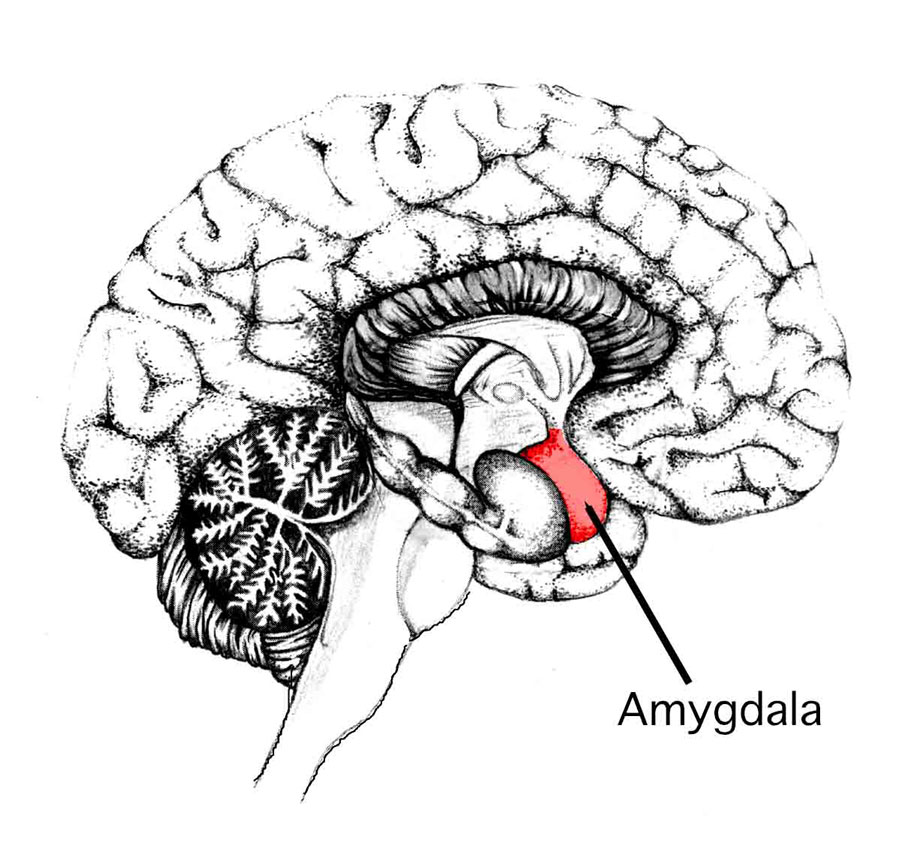
The brain evolved from the bottom up and one of its first structures was the Amygdala. An almond-shaped set of neurons located deep in the brain’s medial temporal lobe.
It plays a key role in the processing of emotions and is linked to both fear responses and pleasure. For this reason it is often known as the “emotional brain”.
While a lot of research concentrates on the rational brain in the frontal cortex, not much is said about the Amygdala even though it plays a central role in so many current problems, including alcoholism, drug addiction, depression, and anxiety disorders.
Here is an in-depth look at the Amygdala.
Emotional learning
The Amygdalae perform the primary roles in the brain of the formation and storage of memories associated with emotional events. The most important of which are the memories that elicit fear behavior.
For dangerous situations this behavior can save our life but in today’s modern world it often acts in a role of paralysis, where the central nuclei is the genesis of many fear responses, including freezing (immobility), tachycardia (rapid heartbeat), increased respiration, and stress-hormone release.
Memory modulation
The Amygdala is also involved in the modulation of memory consolidation. Following any learning event, the long-term memory for the event is not formed instantaneously. Rather, information regarding the event is slowly assimilated into long-term (potentially life-long) storage over time, possibly forming permanent neural pathways.
The formation of those permanent pathways, called long-term potentiation, can become vital for behavior. Creating pathways for anxiety, fear conditioning, can be hard to overcome. Whereas, starting with pathways for positive behavior can improve behavior and help during stressful events.
This kind of positive conditioning can be done as an adult. A study performed on Buddhist monks who do compassion meditation have shown that they can modulate their Amygdala during their practice. When tested they showed a calmer reaction to stress than other people.
The Amygdala is most active when emotional. Greater emotional arousal following an event can enhance a person’s retention of that event. Which makes it interesting because it controls both emotion and memory. The full extent of this “bias” is not fully understood.
The obvious studies on fear and anger show positive correlations, where increased fear (emotion) then increase memory of that fear. Not much study has been completed on the opposite, for example, do positive emotions stimulate the Amygdala to create memory as much as negative ones do.
In nature there is certainly a desire to learn quickly from bad experiences, but is there a similarly strong desire to learn from positive outcomes?
Neuropsychological correlates (behavior and disorders)
As early as 1888, rhesus monkeys with a lesioned temporal cortex (including the amygdala) were observed to have significant social and emotional deficits. Heinrich Klüver and Paul Bucy later expanded upon this same observation by showing that large lesions to the anterior temporal lobe produced noticeable changes, including overreaction to all objects, hypoemotionality, loss of fear, hypersexuality, and hyperorality, a condition in which inappropriate objects are placed in the mouth.
These studies and many more discussed below show that the Amygdala plays a substantial role in mental states, and is related to many psychological disorders.
Of particular focus is the left Amygdala and it’s size.
Some studies have shown that children with anxiety disorders tend to have a smaller left Amygdala which increased in size with the use of antidepressant medication.
The Amygdala exists on both sides of the brain.
Other studies found the left side to be linked to social anxiety, obsessive and compulsive disorders, and post traumatic stress, as well as more broadly to separation and general anxiety.
Similarly, depressed patients showed exaggerated left side activity when interpreting emotions for all faces, and especially for fearful faces. This hyperactivity was normalized when patients went on antidepressants.
Alcoholism and binge drinking also affects the Amygdala by dampening its activation, reducing its ability for emotional processing. This is thought to happen by inhibiting the protein kinase C-epsilon which is important in regulating drug addiction, drinking, and anxiety.
Amygdala Hijack
In 1996, Daniel Goleman wrote the book Emotional Intelligence: Why It Can Matter More Than IQ. In it he described a biological response we sometimes exhibit, naming it the Amygdala Hijack:
“Some emotional reactions and emotional responses can be formed without any conscious, cognitive participation…because the shortcut from thalamus to Amygdala completely bypasses the neocortex (the rational brain)”.
In scientific terms, the Thalamus bypasses the Cortex and routes the signal directly to the Amygdala, which is the trigger point for the primitive fight-or-flight response, and in our modern settings can often result in irrational or destructive behavior.
“Emotions make us pay attention right now – this is urgent – and give us an immediate action plan without having to think twice. The emotional component evolved very early: Do I eat it, or does it eat me?”.
Here is Mr. Goleman explaining it himself:
The emotional response “can take over the rest of the brain in a millisecond if threatened” and exhibits three signs: strong emotional reaction, sudden onset, and post-episode realization that the reaction was inappropriate.
In these cases self-control is crucial so as to avoid a complementary hijacking. For example ‘one key marital competence is for partners to learn to soothe their own distressed feelings…nothing gets resolved positively when husband or wife is in the midst of an emotional hijacking’.
The danger is that ‘when our partner becomes, in effect, our enemy, we are in the grip of an “Amygdala hijack” in which our emotional memory, lodged in the limbic center of our brain, rules our reactions without the benefit of logic or reason…which causes our bodies to go into a “flight or fight” response’.
On the Upside
Finding ways to enlarge your Amygdala can have multiple obvious benefits beyond emotional stability. One study “suggests that Amygdalar enlargement in the normal population might be related to creative mental activity”. Another found positive correlations with both the size (the number of contacts a person has) and the complexity (the number of different groups to which a person belongs) of social networks.
What was left unsaid was how to increase the size of your Amygdala without the use of antidepressants, or maintain the size after terminating use.
One can infer that for those experiencing anxiety or overcome by fear or other emotions, the size of the Amygdala is small. That smaller size leads one to destructive behaviors, flight-or-flight responses, and limited growth.
The recommendations by nearly every study may provide an insight into how one can increase the size of there Amygdala. The reoccurring suggestion was practice, or regular repetition that allows the neurons in the brain to form new pathways and then strengthen those until they form the dominant behavior.
A method I often practice, although I recommend doing it with a trusted friend or therapist involved. Remember, improvement can always be had and nothing about you is set in stone.
The brain evolved from the bottom up and one of its first structures was the Amygdala. An almond-shaped set of neurons located deep in the brain’s medial temporal lobe.
It plays a key role in the processing of emotions and is linked to both fear responses and pleasure. For this reason it is often known as the “emotional brain”.
While a lot of research concentrates on the rational brain in the frontal cortex, not much is said about the Amygdala even though it plays a central role in so many current problems, including alcoholism, drug addiction, depression, and anxiety disorders.
Here is an in-depth look at the Amygdala.
Emotional learning
The Amygdalae perform the primary roles in the brain of the formation and storage of memories associated with emotional events. The most important of which are the memories that elicit fear behavior.
For dangerous situations this behavior can save our life but in today’s modern world it often acts in a role of paralysis, where the central nuclei is the genesis of many fear responses, including freezing (immobility), tachycardia (rapid heartbeat), increased respiration, and stress-hormone release.
Memory modulation
The Amygdala is also involved in the modulation of memory consolidation. Following any learning event, the long-term memory for the event is not formed instantaneously. Rather, information regarding the event is slowly assimilated into long-term (potentially life-long) storage over time, possibly forming permanent neural pathways.
Does anyone ever think about the power that comes with Wall Street?
We are the center of the financial universe and money flows into our country. The dollar is the standard by which everyone else values their currency. Millions upon millions of jobs are created by more than just the big investment banks, but also the small businesses that rarely face a credit crunch.
Nearly every person in this country can get a quick $20k to start a business, whether from a bank or through a credit card.
So, why do the Occupy Wall Street protesters want to put a monkey wrench in the works? Would they rather it be in China?
Perhaps they blame Wall Street for the recession or the bailouts.
That’s a 17.5% default rate for Detroit compared to a 4.6% default rate for Wall Street, and the TARP number is expected to go lower as more money is paid back. That $14 billion automaker loss it’s already on the books.
Further, the Wall Street banks have already paid their loans back, it’s the small community banks across the country who are defaulting.
The main reason they are defaulting: bad home loans.
Which brings up an interesting conundrum. Non-Wall Street banks taking our tax money. People taking on bad mortgages and government regulators performing a classic disappearing act.
Should we think twice about blaming Wall Street?
At the very least take responsibility for our own bad mortgages and elected officials.
You definitely won’t find me out protesting Wall Street — I would feel too guilty as I have an “easy mortgage” that I am underwater on.
I like having my country as the financial power in the world and all the money and jobs that go along with it. Not to mention that it’s better than it being in China or Germany.
Plus, I have work to do. I can’t sit around all day and be angry at other people…