Is Craigslist is done for? (yep)

This is part 1 of 2 which proves that Craigslist is already dead, or in the midst of a slow death.

From Quora

Craiglist has been disrupted, it’s just not obvious yet. And the world will be a better place for it.

Craigslist has fewer unique visitors today than it did at this time in 2009.

Bad sites with network effects show much slower decay in use than they should based on their absolute quality. (think eBay.) Bad sites who price most of their product at free show incredibly slow decay in use. (think Craigslist). But make no mistake, it is happening.

The evidence of their poor quality is so obvious it’s hardly worth stating. Suffice it to say, if I’m looking to rent an apartment, it would be nice not to see the same listing reposted every day, and having to re-read it and figure out if I’ve called them before. It might be even nicer to view them on a map, or god forbid have new and relevant listing emailed to me.

Sites like Oodle have tried to take it head on with a superior interface but have been unable to displace them. Sites like Kijiji have been launched by eBay, or OLX, which is distributed on other people’s platforms with large traffic, have tried to leverage other sources of traffic to combat the critical mass.

Generally speaking, Craigslist has been “good enough” to not be disrupted head-on. Nevertheless, the world moves on, and the gaps in their product (due to a stubborn obstinate refusal to invest in technology) grow wider and wider. As tablets, smartphones, etc disrupt, and craigslist doesn’t invest in those platforms, the feature gap grows wider.

The disruption that has happened has occurred on a category-by-category bases, as this graphic by Andrew Parker (http://thegongshow.tumblr.com/po…) shows:

StubhubAirbnbEtsy have built big businesses in some of these categories, and floods of new startups try to pry off pieces (TaskRabbit, many others).

I have derived a lot of utility out of Craigslist over the years, and it has all come free, so I am grateful for that. But the site reportedly pulls in more than $100M in revenue a year (What is Craigslist’s revenue?) , has only a few dozen employees, continually under-invests in technology and does not innovate. I don’t think Craig’s a bad guy, but he’s harvesting $50M a year into his pockets and not improving the site. In ten years I think Craigslist will be an afterthought, whereas if he reinvested half of those profits into technology and product, it would have a real shot to be a category leader.

Update: Do you think Craigslist is done for….if so Part 2 is now available and it will change your mind – Is Craigslist done for? (nope)

CPC is better than CPM

If you’ve ever wanted to know why CPC is better than CPM and CPA here is a great description why.

CPM – cost-per-thousand

CPA – cost-per-action

CPC – cost-per-click

Cost-per-thousand (CPM) was huge in the early days and very simple, get paid by the thousand viewers. But, it was it very limited in effectiveness. It placed all of the risk on the advertiser. They created the ad and made the payments, while all the website had to do was display the ad (often in the worst locations).

Then, cost-per-action (CPA) came into play where the website had to actually close a deal. The website didn’t get paid unless they got a viewer to buy something (or sign-up for something). This is the most common program used by the wide range of affiliate companies who offer high percentages (5%-15%) of the sale. But, this switches the game by placing all the risk on the website. The website places the ad and no matter how many views or clicks it receives they only get paid if the viewer commits the desired action. The advertiser receives all the free views and clicks with no impetus to create a compelling ad.

Finally, the balance came with cost-per-click (CPC). In this case the website gets paid for each click on the ad and it forces them to display it in the best possible spot. It also encourages the advertiser to create an interesting and relevant ad because they still need to convert the click into an action (purchase, sign-up).

For more information visit infolific: CPM vs CPA vs CPC.

Surviving depression in a relationship

“The trick to surviving in a relationship with a depressive–or an alcoholic for that matter–is to firmly maintain your boundaries, or, as we would put it, be aware of and insist on getting your needs met. Any relationship is a mutual satisfaction of needs, regardless of either party’s state of health.”

“Establishing clear and consistent boundaries can be very hard because often our natural inclination is to try to make the sufferer feel better, to rescue. I have known people who have gone broke trying to appease the demands of the inner demons that torment their partner, trying to make it right for them, trying to make them happy.”

Dr. Bob

Green surfboards

The best surfboards in the world are the most toxic. Take any professional surfer and she/he will be riding a high tech stick packed with the latest innovations. It will also be the worst possible board for the environment not only in its materials, but in the creation, disposal, and in effects on workers creating the boards.

The good news is that many small business are developing alternatives. UK-based company, Ocean Green, is bringing back the all wood board by hollowing out a Balsa-wood plank and using bio-degradable fiberglass cloth.

Country Feeling, a Hawaii based shaping group co-founded by Jack Johnson, is developing a soy and sugar-based foam and a solar cured resin.

There is also a movement to recycle everything from the foam dust to the actual boards themselves. Green Foam collects the excess dust tossed out in shaping shacks to make new foam for boards.

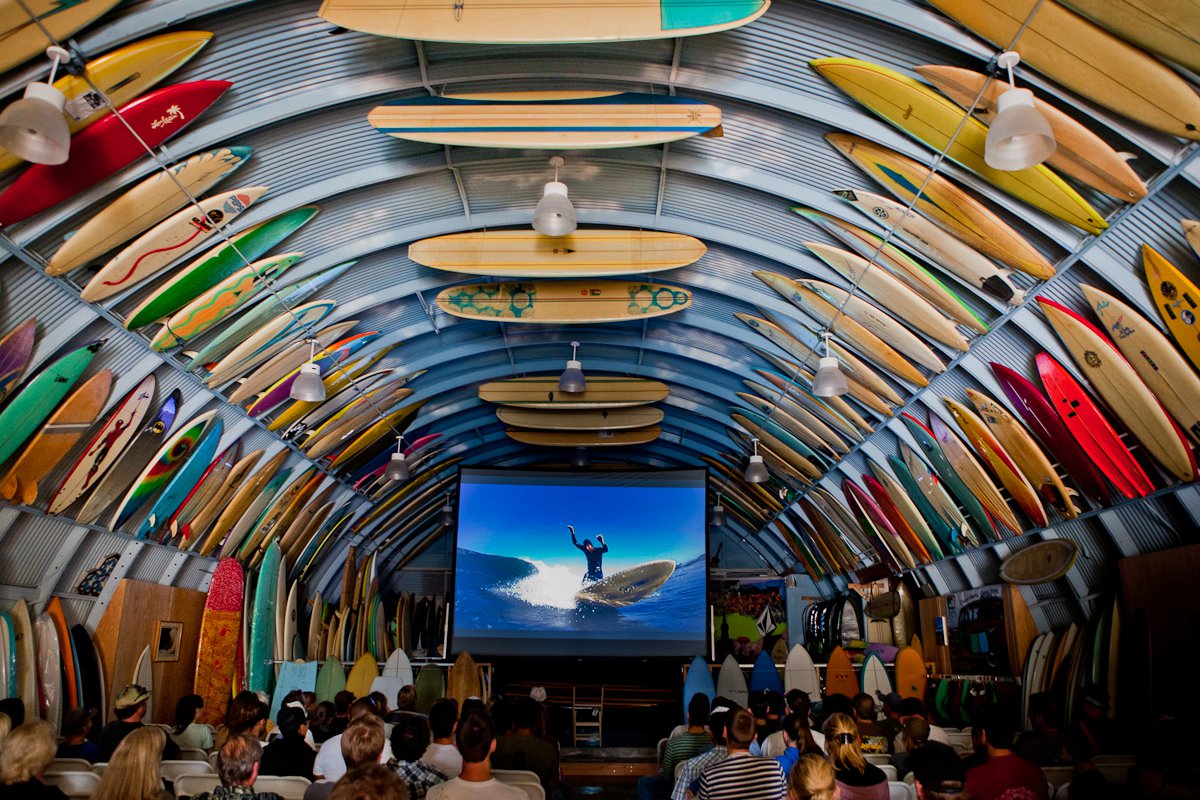
The movement is starting to catch on among the pro’s (Kolohe Andino rides a recycled foam board) and the crowds. There is even a new surf film digging into this, Manufacturing Stoke:

No other sport is so intrinsically linked to nature. Some call it a spiritual experience, most call it indescribable. And yet, in becoming the multi-billion dollar industry it is today, a great paradox has risen. Surfers are indeed directly connected to the earth’s pulse and yet a majority of the materials used are environmentally toxic.

Still, this whole story largely unknown. Only a few of the large companies are taking it seriously which means even fewer surfers are interested. Surf wax and wetsuits also have their own toxic problems and are in need of an overhaul.

Which means its all about grass roots growth. Tell your friends, experiment in your garage, and spend your dollars on what you care about.

How did it get this way?

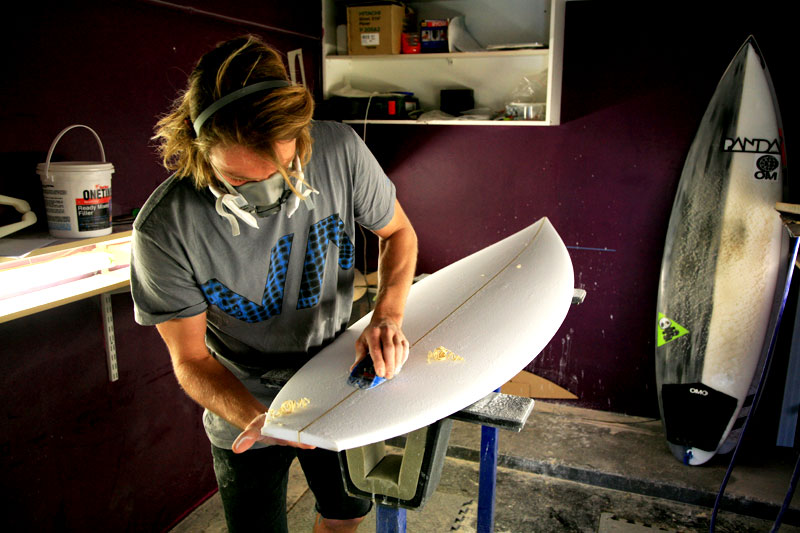
We’ve all seen the classic image of a shaper wearing the breathing mask. Heard the tale of the young protégé shaper sweeping up foam dust. But, have you ever thought about why the mask is needed, can you think of any other profession where people need them?

There’s not many of them left in the country because these compounds are toxic. Most are banned in several states or highly controlled due to their volatile nature. We are talking about cancer, deformations, groundwater contamination, ocean pollution…here are some of their names:

Toluene Diisocynate, Polystrene, Polyurethane, Chromium, Dicarboxylic Acids, and Dihydroxy Alcohols.

An explanation of how we got here starts back in the 60’s with the massive 10-foot long wood planks. They were heavy, so heavy that you had to balance it on your head and cart it around in “woody” wagons. These boards defined the early era of surfing and the longboard riding style (slow, long curves at special breaks).

Then modern technology stepped in: foam, fiberglass, and resin. The wood was whittled down to a thin strip in the center for strength (stringer) and the rest was taken up by foam, then shined up with fiberglass in resin. The result was a lighter, faster, and more agile board.

It revolutionized the sport. Made it the worldwide industry it is today. Then it all came crashing down in 2005.

A series of factors contributed to this change, the largest of which was the shutting down of Clark Foam. This giant supplier of foam for boards worldwide came under the cross hairs of government (all of them). The city, county, state, and federal authorities wanted a cleaner factory and Gordon Clark couldn’t take it.

The story is still unclear, whether Gordon refused to clean-up or the city simply wanted him gone. It is probably somewhere in the middle but the lawsuits, criminal charges, and cancer-riddled workers speak to some truths.

Namely, the growth of the surfboard industry is creating a lot of waste and pollution. As the government stepped in it found that nearly every element of the modern surfboard involved toxic chemicals or volatile organic compound.

The regulators clamped down and the surfboards manufacturers went abroad or went mechanical. Hoping to outsource the pollution or remove the worker from the shaping. Clearly the industry didn’t want to face it’s own problems.

Which now puts the industry on the verge of a new breakthrough. A revolution in materials to bring about a cleaner, safer way to enjoy the sport we love.

***

father/son photo by Mike Baird

Paddle 2 Live – Wednesday Workouts – 4 mile paddle

Have you ever left the shore? Gone beyond the surf into the open ocean? On a 10-foot foam board?

To many it’s a Wednesday ritual where they paddle 4 miles out to the RS4 Bell Buoy.

Seals love the buoy.

For others (like me) it’s a panic attack waiting to happen with images of sharks, storms, barracudas, and 100 foot waves. Not to mention the stamina needed to paddle 4 miles in the open ocean. Is that like running 4 miles?

I’m still gonna do it though. What is life without adventure, you know.

Here are the details.

Paddle 2 Live – Wednesday Workouts

Wednesdays · 6:30am – 8:30am

Newport Beach Pier (Blackies next to the dory launch)
2122 West Oceanfront
Newport Beach, CA 92663

Every Wednesday morning, rain or shine, choppy or glassy we will be paddling. Join us at the North side of the Newport Beach Pier (Blackies) and paddle with us to the RS4 Bell Buoy and back which is about 4-miles roundtrip. 6:30am sharp arrival, 6:45am start, sunscreen will be provided. All paddlers welcome! All ages, all levels. Prone, SUP, Rescue boards, whatever you got…

Paddle Surf Warehouse Meetup.com Group

Vimeo event page

How Do I Become A Data Scientist?

In the last post we tried to explain what is a Data Scientist. Now, with all the job openings for them we approach how to become one.

A Quora thread offers some advice:

Strictly speaking, there is no such thing as “data science”. (With that in mind) Here are some resources I’ve collected about working with data, I hope you find them useful  (note: I’m an undergrad student, this is not an expert opinion in any way).

1) Learn about matrix computations:

Take the Computational Linear Algebra course (it is sometimes called Applied Linear Algebra or Matrix Computations or Numeric Analysis or Matrix Analysis and it can be either CS or Applied Math course).

2) Start learning statistics

3) Learn about distributed systems and databases:

  • Note: this topic is not part of a standard Machine Learning track but you can probably find courses such as Distributed Systems or Parallel Programming in your CS/EE catalog. I believe it is important to learn how to work with a Linux cluster and how to design scalable distributed algorithms if you want to work with big data. It is also becoming increasingly important to be able to utilize the full power of multicore.
  • Download Hadoop and run some MapReduce jobs on your laptop in pseudo-distributed mode.
  • Learn about Google technology stack (MapReduce, BigTable, Dremel, Pregel, GFS, Chubby, Protobuf etc).
  • Setup account with Amazon AWS/EC2/S3/EBS and experiment with running Hadoop on a cluster with large data sets (you can use Cloudera or YDN images, but in my opinion you can better understand the system if you set it up from scratch, using the original distribution). Watch the costs.
  • Try out Hadoop alternatives, specifically the minimalist frameworks such as BashReduce:
  • Run Bryan Cooper’s Cloud Serving Benchmark on AWS, compare Hbase vs Cassandra performance on a small cluster (6-8 nodes)
  • Run LINPACK benchmark
  • Run some experiments with MPI try to implement a simple clustering algorithm with MPI vs Hadoop/MapReduce and compare the performance, fault tolerance, ease of use etc.  Learn the differences between the two approaches, and when it makes sense to use each one.

4) Learn about machine learning

5) Learn about least-squares estimation and Kalman filters:

  • This is a classic topic and “data science” par excellence in my opinion. It is also  a good introduction to optimization and control.
  • Start with Bierman’s LLS tutorial given to his colleagues at JPL, it is clearly written and is inspiring (the Apollo trajectory was estimated using these methods).
  • See Steven Kay’s series on statistical signal estimation