They also have several songs you can purchase on iTunes, like the Feliz Navidad song.
Favorite commercials: Feliz Navidad from Jorge and Alexa Narvaez
They also do an amazing cover of Home.
Long lost words: Debonair
deb·o·nair // debəˈne(ə)r
- (of a man) Confident, stylish, charming.
- Having a sophisticated charm; “a debonair gentleman.”
Mae West and the double entendre
I was looking through the historical photos from the L.A. Times and found this one of Mae West:

Mae West (1893 – 1980) was an American actress, playwright, screenwriter and sex symbol whose entertainment career spanned seven decades.
Known for her bawdy double entendres, West made a name for herself in Vaudeville and on the stage in New York before moving to Hollywood to become a comedienne, actress and writer in the motion picture industry.
The American Film Institute named West 15th among the greatest female stars of all time.
via Wikipedia
Quotes – Mae West’s double entendres
“When choosing between two evils, I always like to try the one I’ve never tried before.”
“I’m the kinda girl who works for Paramount by day, and Fox all night”
“I feel like a million tonight—but only one at a time”
“All discarded lovers should be given a second chance, but with somebody else.”
“I speak two languages, Body and English.”
“I’ll try anything once, twice if I like it, three times to make sure.”
“When I’m good I’m very, very good, but when I’m bad, I’m better.”
“Love thy neighbor–and if he happens to be tall, debonair and devastating, it will be that much easier.”
“The score never interested me, only the game.”
“It’s not the men in my life that counts–it’s the life in my men.”
“Love isn’t an emotion or an instinct–it’s an art.”
We create our own stars – the satellites tracking U.S. weather
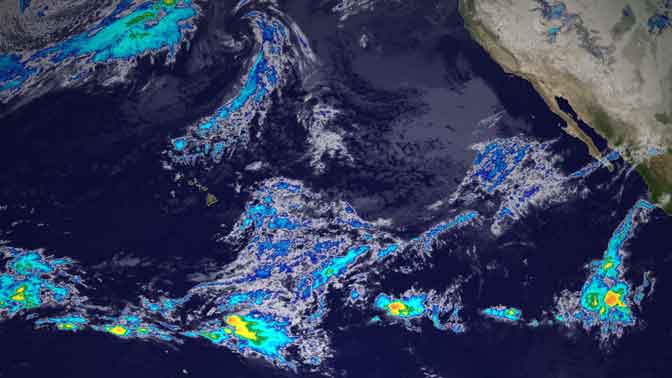
The National Ocean and Atmospheric Administration (NOAA) brought online its latest weather satellite GOES-15, and pushed aside its predecessor GOES-11.
It will be tracking the weather for California, the west coast, Hawaii, and the Pacific Ocean. The image above is the first infrared image it sent to NOAA, which it will continue to do every “15-30 minutes, with full hemisphere scans every 3 hours until its retirement.”
The term GOES stands for Geostationary Operational Environmental Satellite. Which means that they sit, like a star, at the same place in the sky and a radio antenna can be permanently pointed at it to receive data.
There are currently four of them covering our globe:
- GOES-12 – South America located at 60°W.
- GOES-13 – East located at 75°W. It provides most of the U.S. weather information.
- GOES 14 – in on-orbit storage at 105° W.
- GOES 15 – West and Pacific Ocean located at 135° W.
They are up there to track half the world’s weather patterns and to “track space weather, oceanographic changes, forest fires and other hazards and provide scientific data collection and information for search and rescue operations.”
As the name implies, there are 15 or more of these satellites up in space. Some are online, one is in storage ready-for-action, others are floating space junk, and a few are floating nonchalantly but providing data (like one at the North Pole).
Next time you look up at the stars keep an eye out for one of these satellites and you can bet they will be keeping an eye on us.
—
For more information, science writer Gary Robbins has a profile on GOES-15 vs GOES-11.
Science wallpapers from the National Ocean Service

National Ocean Service Wallpapers – also has holiday, jellyfish, waves, eels, turtles, sunsets, birds, boats, and more.
Favorite commercials: Monday inspiration, Think Different from Apple (full version)
I watch this a lot to feel inspired. Saving for future reference.
The face of courageous sacrifice and suffering, Jean d’Aire – sculpture by August Rodin
On August 1, 1347, the city of Calais in France had fallen. The siege had been long, over 8 months, and the citizens were proud of their massive castle which was over 1,000 yards wide, surrounded by two moats, and protected by the sea at its back.
The terms of the surrender were the lives of the six noblest men in the city. These men, called burghers, were to leave the city with a noose around their neck and present themselves and the keys to the city to the conquering king, Edward III of England.
The most prominent of them all was Jean d’Aire and his face says it all.

Over 500 years later the citizens of Calais asked sculptor August Rodin to commemorate that day with a statue of all six burghers marching to their doom. He complied and ended up creating one of his best masterpieces.
The bust you see above is but one part of the statue, albeit the most famous. In later years Rodin would create several copies of that face for busts and in giant size. Today, you can find these copies all around the world at museum, parks, and in Calais.
But, first the original: